Designing the Frame: Elevate Sets with Strategic Movie Furniture
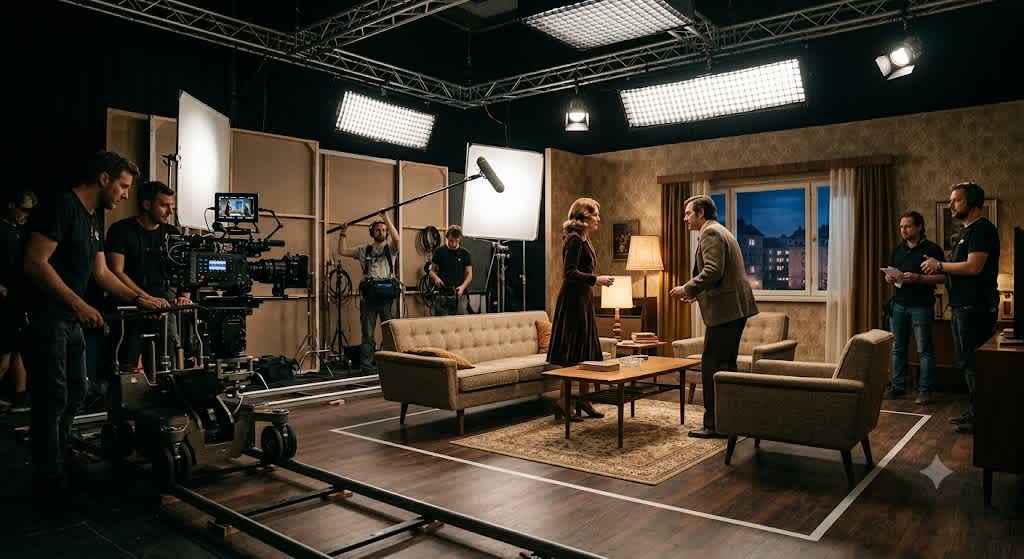
On a quiet soundstage in Babelsberg or Nu Boyana, a production designer faces a high-stakes puzzle that never appears in the script. The director wants a tight tracking shot through a crowded 1970s parlor. The cinematographer demands low-angle lighting that casts precise shadows across the rug. Meanwhile, the lead actor needs room to pivot dramatically toward a window—without tripping over a coffee table.
This is the hidden geometry of filmmaking. Every couch, armchair, and dining table placed on a set is more than just background decoration; it is a critical piece of structural storytelling. When chosen wisely, movie furniture anchors the aesthetic world while serving the rigid physical demands of camera tracks, lighting grids, and actor movement. Balancing artistic narrative with practical spatial constraints is the ultimate game of cinematic chess. Here is how top European art departments navigate spatial physics, tight budgets, and lens choices to pull it off seamlessly.
The Intersection of Film Blocking and Spatial Physics
Visual storytelling relies heavily on physical space. Film blocking—the precise staging of actors within a camera’s frame—defines how tension, intimacy, and power dynamics flow across a scene. However, even the most brilliant blocking plan falls apart if physical set pieces obstruct the camera’s path or restrict an actor’s organic movement.
To manage spatial physics effectively, art directors evaluate three-dimensional set clearances:
- Horizontal Clearances: Furniture depth must accommodate dolly tracks, Steadicam paths, and actor turnaround radii without crowding the lens path.
- Vertical Sightlines: Physical profiles must match lens height (such as low-angle hero framing or overhead master shots) without clipping key overhead lighting fixtures.
- Modular Mobility: Set pieces need quick-release joints or concealed casters to support rapid focal-length changes between setups.
When staging high-density interiors, production designers must treat movie set furniture as modular components rather than static interior decor:
- Dolly and Rigging Clearances: Standard residential furniture often features wide, rigid footprints that trap camera operators. Set-ready pieces utilize tapered legs and reduced depth profiles to maintain visual mass on camera while leaving essential floor space open for dolly tracks and jib arms.
- Actor Movement Zones: An actor rising abruptly from an armchair needs clear swing radius and balance support. Cushion density must be customized—overly soft domestic sofas cause actors to sink, ruining seamless standing transitions during continuous takes.
- Modular Breakdown: High-end set pieces often feature breakaway legs, hollowed-out backs, or hidden magnetic latches. This allows crew members to strip away half of a sofa in seconds to let a tight 85mm lens get right up against an actor’s shoulder.
Framing for the Lens: How Furniture Shapes the Frame
A camera lens does not perceive depth the way the human eye does. Wide-angle lenses (such as 18mm or 24mm) distort foreground elements and stretch depth, making nearby objects appear huge. Conversely, telephoto lenses compress space, squishing foreground decor flat against background walls. Selecting film furniture requires understanding how focal length alters physical volume.
Navigating Anamorphic and Spherical Glass
Anamorphic lenses introduce unique horizontal squeeze and distinct depth-of-field falloff. A high-backed sofa that looks balanced in real life can slice a wide 2.39:1 anamorphic frame directly in half.
To maintain visual harmony, art departments select low-slung, horizontal silhouettes for wide anamorphic compositions. For tight spherical close-ups, textured chair backs—featuring velvet tufting, rattan weave, or aged leather—serve as rich bokeh elements that catch ambient key lighting.
Studio Lighting Interaction and Reflectivity
Lighting an interior scene demands precise control over glare and spill. Glossy lacquered tables or polished metallic chrome frames reflect high-powered studio lights directly into the camera lens, creating unwanted flares and blowing out highlight details.
Europe’s leading prop houses and fabrication workshops counter this by applying matte clear-coats, hand-rubbed wax finishes, or subtle distress techniques to set dressing. These treatments preserve the luxury aesthetic under harsh LED or tungsten rigs while eliminating dangerous hot spots.
Budget vs. Aesthetic: Smart Sourcing for European Productions
Managing art department budgets across European co-productions requires strategic resource allocation. Sourcing authentic vintage or high-end contemporary items for every scene quickly exhausts capital. Creative departments stretch their funds by tiering their prop strategies according to visual prominence:
- Tier 1: Hero Furniture (Direct Actor Interaction)
Hero items—the chair a protagonist occupies during a tense interrogation, or the desk across which a contract is signed—demand the highest build quality and authentic tactile feedback. Allocate budget here for bespoke fabrication or premium period rentals. - Tier 2: Mid-Ground Set Dressing
Items that frame the primary action require visual character but less functional durability. European art crews often source flat-pack or commercial pieces, aging them with paint patinas or re-upholstering them with period-accurate fabric to achieve a high-budget cinematic experience at a fraction of the cost. - Tier 3: Background Fill
Elements positioned beyond the depth-of-field plane require silhouette value over intricate detail. Lightweight replica models or altered second-hand props keep background spaces rich without draining transport or rigging budgets.
Real-World Case Study: Sourcing the Perfect Period Sofa
Consider a mid-budget period drama shot on location in Prague, requiring an opulent 1920s Parisian salon setting inside a narrow historic building. The script called for a key conversation between two leads on a central sofa, surrounded by active tracking shots.
- The Challenge: An authentic 1920s antique sofa was found, but it was too deep (110 cm), causing dolly wheels to bump its frame. Furthermore, its ultra-soft horsehair stuffing caused the actors to slump, pushing their heads below the primary key light plane.
- The Solution: The production designer commissioned a modified replica movie set furniture piece. The team built a sofa with a reduced depth profile (80 cm), firm high-density seating foam (50 kg/m³), and a modular back panel that unclipped in three sections.
- The Result: The camera team pulled off dynamic 360-degree tracking shots through tight quarters. The actors stayed perfectly positioned within the lighting focal zone, saving hours of costly set adjustments and preserving the scene’s emotional punch.
Balancing Form, Function, and Cinematic Realism
A memorable visual world is built on intentional details. Every couch cushion, desk angle, and wood finish contributes to character development and spatial atmosphere. By viewing movie furniture through the combined lenses of camera geometry, lighting control, and blocking flow, art directors elevate the narrative while keeping production logistics running like clockwork.
Prioritize pieces that offer structural versatility, matte finishes, and actor-friendly ergonomics. When your set dressing harmonizes with camera movement and lighting setups, the physical environment disappears into the story—delivering a seamless, immersive experience for audiences across the globe.
Conclusion: Mastering the Spatial Chessboard of Film Production
In the fast-paced environment of European film production, high-impact set design rarely happens by accident. The interplay between actor placement, camera movement, and studio lighting leaves no room for inflexible set pieces. Treating your movie furniture selection as a strategic extension of technical filmmaking ensures that your world-building remains striking without frustrating the camera crew or blowing the art department budget.
Ultimately, purpose-built and intelligently adapted movie set furniture serves as the bridge between creative vision and physical reality. By selecting modular, camera-ready pieces that respect focal lengths and dolly tracks, art directors give their teams the freedom to execute complex film blocking effortlessly. When spatial mechanics and visual storytelling align, the set transforms into a dynamic canvas that captivates audiences and elevates the entire cinematic experience.
Frequently Asked Questions
Why is specialized movie furniture preferred over standard commercial furniture?
Standard commercial items are built purely for domestic comfort and static spaces. Set-ready furniture is engineered for set logistics—featuring lightweight frames, non-reflective finishes, custom seat heights to maintain actor posture, and modular designs that accommodate camera rigs.
How do production designers prevent light reflections on glossy furniture?
Art departments apply specialized anti-glare sprays, dulling sprays, matte clear-coats, or natural hand-waxed finishes. These techniques retain the texture and character of materials like wood, metal, or leather without reflecting high-intensity lights into the camera lens.
How does lens focal length affect set dressing choices?
Wide-angle lenses exaggerate foreground items, making oversized pieces look disproportionately large. Telephoto lenses compress depth, flattening distance between background and foreground elements. Designers pick silhouettes and textures that match the specific lens package chosen by the cinematographer.