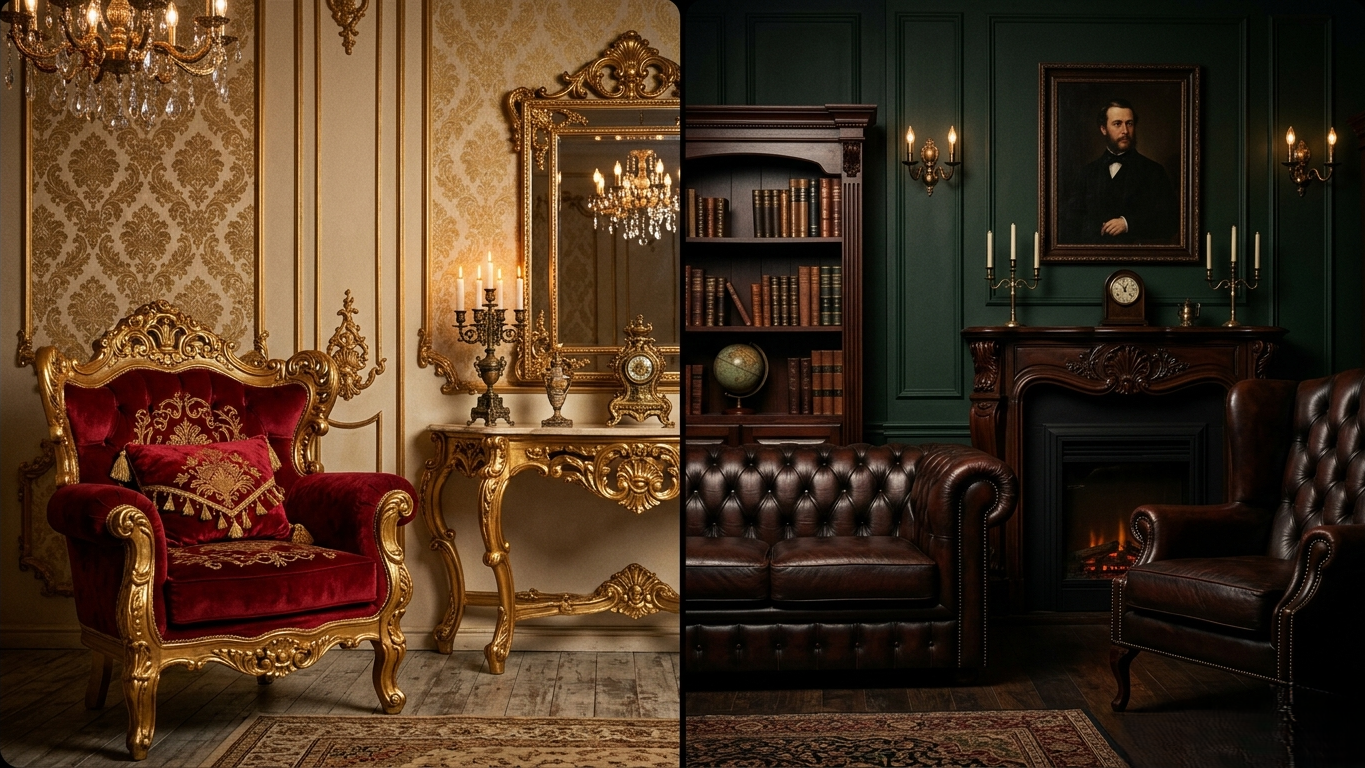
Victorian vs. Baroque: Choosing the Right Film Props Furniture
Every period production lives or dies by the authenticity of its visual detail. For art directors and production houses working on Hollywood features or premium OTT series, few decisions carry more weight than selecting the right era of furniture for a script-accurate set. Victorian and baroque are two of the most frequently referenced styles in film production briefs — and two of the most commonly confused. Understanding the visual, structural, and atmospheric differences between them is not merely an academic exercise. It is a practical skill that directly shapes how audiences read a scene, a character, and a story.
This side-by-side guide is designed to give art directors a clear framework for distinguishing between the two periods and making confident, script-driven decisions when sourcing film furniture for any production.
Two Eras, Two Entirely Different Visual Languages
At first glance, both baroque and Victorian interiors share a certain richness — layers of ornament, substantial silhouettes, and a preference for opulence over restraint. But the intention behind that opulence is entirely different, and those differences read clearly on screen.
Baroque design, rooted in 17th-century Catholic Europe, was conceived as an instrument of awe. It was meant to overwhelm — to communicate divine authority, aristocratic power, and theatrical grandeur. The furniture of the baroque era reflects this purpose. Carved gilded frames, exaggerated curved legs, deep jewel-toned velvets, and dramatic proportions were not decorative choices but deliberate statements of dominance. When you place authentic baroque film props furniture in a scene, you are placing power itself into the frame.
Victorian design, by contrast, emerged from 19th-century industrial Britain. Where baroque reached upward toward spectacle, Victorian interiors reached inward toward comfort, propriety, and the ordered respectability of the emerging middle class. Victorian film furniture is characterised by darker, more restrained wood finishes, heavily padded upholstery in muted tones, functional forms decorated with floral or Gothic Revival motifs, and a general sense of domestic solidity rather than courtly excess.
Key Visual Differences Art Directors Must Know
The fastest way to distinguish the two styles on a sourcing floor or in a prop house catalogue is to focus on three elements: the leg, the frame, and the fabric.
Baroque legs are boldly curved — cabriole forms, scrolled feet, and exaggerated turned profiles are hallmarks of the period. The frames of baroque movie set furniture are typically gilded or painted in contrasting tones, often with carved figural or foliate detail. Fabrics run to rich velvets, silks, and brocades in deep golds, crimsons, and forest greens.
Victorian legs, by comparison, are straighter and more architecturally grounded. Turned legs with simple bulbous or tapered profiles dominate. Victorian film props furniture frames are almost exclusively in dark stained or polished wood — walnut, mahogany, and ebonised finishes — with minimal gilding. Upholstery fabrics lean toward wool, cotton damask, and tapestry weaves in burgundy, olive, slate blue, and black.
Understanding these distinctions allows you to make rapid, confident sourcing decisions without needing to consult a design historian on every scout.
Matching the Style to the Script
The choice between baroque and Victorian film furniture should always begin with the script and the character. Baroque settings communicate power that has been inherited — ancient wealth, aristocratic lineage, religious authority, or theatrical villainy. They work compellingly in stories involving European courts, corrupt nobility, secret societies, or morally complex antagonists surrounded by beauty and menace in equal measure.
Victorian settings communicate power that has been earned — or anxiously maintained. They suit productions dealing with colonial-era tension, bourgeois ambition, Gothic horror, repressed emotion, or the social machinery of empire. A Victorian drawing room dressed with precise film props furniture tells an audience immediately that the world of this story is one of rules, appearances, and consequences.
For Hollywood productions and high-end OTT series set in modern penthouse environments or luxury interiors, baroque movie set furniture offers a far stronger visual contrast against contemporary architecture. Its drama and scale translate powerfully to widescreen formats and streaming displays. Victorian pieces, while equally authentic, tend to read as quieter and more domestic — better suited to chamber drama than to high-concept visual storytelling.
Sourcing the Right Era Without Overspending
Across European antique markets, both baroque and Victorian film furniture are available at production-friendly price points when you know what to look for. Prop houses in the UK, France, and the Netherlands hold particularly strong stocks of Victorian pieces, while baroque film props furniture is most reliably sourced through specialist dealers in Belgium, Italy, and southern Germany.
When budgets are tight, a single era-defining hero piece — a carved baroque console or a buttoned Victorian chesterfield — is sufficient to anchor the entire visual identity of a set. Supporting pieces can be sourced at lower cost or dressed with period-appropriate textiles to extend the aesthetic convincingly.
The Right Choice Is Always the Script’s Choice
Victorian and baroque are not interchangeable. Each carries its own emotional register, its own class associations, and its own cinematic weight. For art directors and production houses committed to script-accurate set design, investing time in understanding the distinctions between them is as important as any other element of pre-production.
Choose baroque film furniture when your story demands spectacle, dominance, and emotional intensity. Choose Victorian film props furniture when your narrative calls for restraint, social tension, and the quiet menace of propriety. Either way, the furniture you place on screen will speak — make certain it is saying exactly what the script intends.