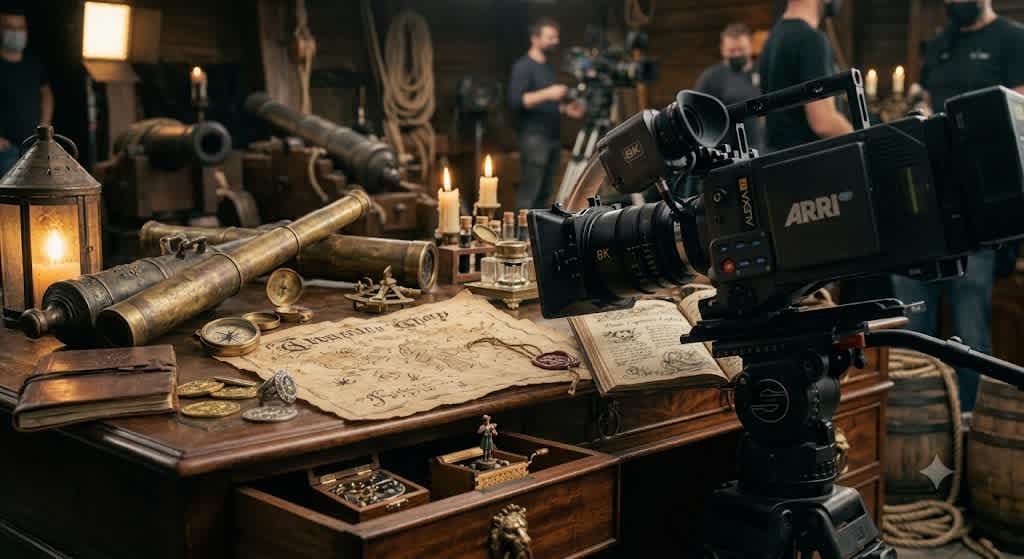
Why 8K Lenses Demand Authentic Movie Furniture
The texture of cinema has changed. For decades, set designers relied on the “magic of Hollywood” to mask shortcut materials. Under the soft glow of traditional film stock, a painted plastic column could pass for marble, and a veneered particle board easily mimicked a century-old antique. However, the rapid adoption of digital cinematography has shattered those illusions. Modern cameras capture an unprecedented level of detail, transforming what used to be a background asset into a focal point.
Today, European film production houses face a stark reality: false finishes crumble under the unforgiving scrutiny of modern tech. To meet this challenge, standard set dressing is giving way to high-caliber procurement. Forward-thinking studios are partnering with specialists like Luxury Group International Ltd. to source authentic movie furniture that stands up to intense visual inspection. When every pore of wood grain and every microscopic flaw in hand-forged metal is magnified on a massive screen, material authenticity is no longer a luxury—it is a production absolute.
The 8K Resolution Trap: How Close-Up Cinematography Exposes Faux Textures
The shift from standard high definition to 8K and beyond has completely rewritten the rules of set design. When a camera sensor captures tens of millions of pixels per frame, it acts as a microscope. Directors are pushing the boundaries of close-up cinematography, lingering on textures to build mood, establish character wealth, or convey historical depth.
[Traditional Film Stock] —-(Soft focus, forgiving)—-> Faux Finishes Pass
[Modern 8K Digital] —-(Ultra-sharp texture)—-> Faux Finishes Fail
If an actor rests their hand on a desk that is supposed to belong to a 19th-century aristocrat, a faux finish will immediately betray the scene. Painted wood grain lacks the microscopic depth, natural pores, and subtle light-absorption properties of genuine timber. Instead of reflecting light like real wood, synthetic laminates bounce light back with a uniform, plastic sheen that instantly pulls an educated European audience out of the story. To maintain immersion, the physical assets on a soundstage must be as flawless as the digital effects added in post-production.
Beyond Aesthetics: The Material Authenticity Demanded by Modern Lenses
True luxury cannot be faked on a modern camera sensor. When a script calls for a high-end environment—whether it is a corporate boardroom in Frankfurt, a historic estate in the French countryside, or a sleek contemporary penthouse in Milan—the environment speaks before the characters do. Achieving true material authenticity requires a deep understanding of how raw elements interact with studio lighting.
- Real Timber vs. Veneers: Genuine hardwoods like walnut, oak, and mahogany have a cellular structure that creates variable depth. When a camera moves across the surface, the angle of reflection changes naturally. Veneers and printed laminates look flat, killing the illusion of luxury.
- Authentic Metals vs. Metallic Paints: Hand-forged iron, solid brass, and brushed steel possess a specific weight and microscopic surface texture. Metallic paints lack these crystalline structures, looking dull and artificial during dramatic close-ups.
- Genuine Leather: Real leather stretches, creases, and ages organically. Under intense studio lights, synthetic leather reflects light with an unnatural, uniform gloss that screams low quality.
By investing in true material quality, European production houses ensure that every frame looks rich, tactile, and irrefutably real.
Sourcing Camera-Ready Finishes: A Blueprint for European Production Houses
Sourcing set pieces that are truly ready for the camera involves more than just browsing high-end retail catalogs. It requires an editorial eye that understands the technical demands of a film set. Movie furniture must be robust enough to handle heavy production crew traffic while possessing the delicate visual nuances required by director-level close-ups.
To secure camera-ready finishes, production teams must look for structural hallmarks that translate well on film. This includes hand-carved detailing that creates natural shadows, mortise-and-tenon joinery that signals historical accuracy, and organic patinas that cannot be replicated in a scenic paint department.
Furthermore, logistics play a massive role in European filmmaking. Sourcing these heavy, high-value assets across fragmented European markets requires a streamlined supply chain. Production houses need partners who can bridge the gap between fine furniture artisans and the rapid, demanding timelines of an active film set, ensuring that the final assets arrive intact and fully prepared for the director’s viewport.
Movie Furniture as a Core Production Essential
Every line item in a film budget is scrutinized, but experienced producers know that cutting corners on set environments is a false economy. High-end, authentic set pieces have transitioned from simple set dressing to absolute movie production essentials.
When a set feels entirely authentic, it fundamentally changes how a scene is shot. Directors gain the freedom to place the camera anywhere, executing tight tracking shots and intimate close-ups without worrying about exposing a fake background.
┌──► Greater Camera Freedom & Unrestricted Angles
Real Movie Furniture ───┼──► Elevated Actor Performance via Tactile Realism
└──► Drastically Reduced Digital Clean-Up Costs
Moreover, physical realism directly impacts performance. Actors respond to their environments. Sitting at a massive, solid-oak desk that carries genuine weight and history evokes a completely different physical presence than sitting at a hollow, prop-shop replica. The tactile feedback of real materials grounds the performance, creating a seamless loop of realism between the actor, the environment, and the camera lens.
The Financial Reality: Why Real Materials Save Money in Post-Production
While authentic sourcing requires a higher upfront investment, it yields significant savings during post-production. In the era of ultra-high-definition film, fixing a fake-looking prop in the digital suite is an incredibly expensive process.
[Upfront Prop Investment] <—————— Slashes Digital Clean-Up Costs
[Fake Prop Shortcut] ──(Exposed by 8K)──► High-Hour CGI Texture Painting
Digital artists must spend dozens of hours tracking the prop across frames, artificially injecting grain, adjusting specular maps, and painting over unnatural reflections. These VFX hours accumulate rapidly, often dwarfing the cost of renting or purchasing an authentic asset in the first place. By ensuring that every piece of furniture is completely genuine on the day of the shoot, production houses eliminate the need for digital fixes, keeping the post-production budget focused on elements that actually require visual effects.
Frequently Asked Questions
Why can’t digital grading fix faux finishes on movie furniture?
Digital color grading can alter tones and contrast, but it cannot invent texture or fix the way light scatters across a surface. If a prop lacks the natural pores of real wood or the crystalline structure of genuine metal, ultra-HD lenses capture that flatness. No amount of post-production grading can inject three-dimensional material authenticity into a flat, two-dimensional fake finish.
What makes a piece of furniture truly camera-ready?
A piece is considered camera-ready when its surfaces, joints, and finishes look entirely convincing under intense studio lighting and close-up cinematography. This means avoiding synthetic glues that seep from joints, avoiding printed patterns, and ensuring that any distressing or patina has been achieved organically or through expert artisan hand-carving.
How do European production houses balance tight schedules with authentic prop sourcing?
Leading EU production houses rely on specialized global networks and supply partners like Luxury Group International Ltd. to handle the logistics. Instead of sending prop masters to comb through scattered antique shops, studios utilize curated B2B channels that specialize in high-end, historically accurate, and physically authentic movie production essentials, ensuring rapid delivery directly to the studio floor.
Conclusion: Securing the Future of Cinematic Immersion
As display technology continues to advance, the margin for error on film sets will shrink even further. Audiences watching content on premium screens can spot the difference between genuine luxury and cheap imitations instantly. To maintain absolute immersion, European cinema must commit to physical realism from the very start of the production process.
Partnering with established asset experts like Luxury Group International Ltd. allows production teams to secure premium movie furniture that easily withstands the gaze of any lens. Investing in real wood, authentic metals, and hand-carved details protects the director’s visual narrative, elevates the actors’ performances, and safeguards the production budget from ballooning VFX fixes. In the modern landscape of filmmaking, material authenticity is the ultimate tool for cinematic storytelling.